

Like most ecommerce brands, you already collect social proof. You have reviews, UGC, and customer feedback that show how your product performs and how people experience your brand. That’s a solid start.
But collection alone isn’t enough. Without a system, social proof stays fragmented and underutilized, scattered across platforms instead of actively influencing buying decisions.
When you set up a deliberate system to collect, organize, and distribute social proof, it fuels discovery, speeds up evaluation, drives purchases, and brings customers back.
This guide breaks down how to build a social proof ecosystem that drives consistent trust, sales, and long-term growth.
What is a social proof ecosystem?
A social proof ecosystem is a system for consistently collecting, organizing, and activating customer trust signals across your entire customer journey.
Instead of treating reviews, UGC, referrals, and creator content as isolated assets, a social proof ecosystem connects them into a single feedback loop. Proof is captured at the right moments, tagged and stored centrally, and redistributed wherever buyers make decisions, like ads, product pages, post-purchase flows, and community channels.
The result is compounding trust. Each customer interaction reinforces the next: real experiences drive credibility, credibility drives conversions, and conversions create more proof to fuel the system.
Why most brands underutilize social proof
You already have reviews, user-generated content (UGC), creator content, and customer conversations coming in consistently. The problem starts after that.
Without structure, proof gets collected but never fully used. So, its impact stays limited even as volume grows.
Here’s where it usually breaks down:
- Proof lives in silos: Reviews sit on product pages, UGC stays on social platforms, creator content lives in campaign folders, and affiliate mentions aren’t tracked at all. Because these signals aren’t connected, buyers rarely see the right proof at the moment it matters most.
- Proof is collected too late or used once: Social proof is usually collected out of habit. It’s requested once, published once, and then forgotten. Even when it clearly helps conversions, it rarely gets reused across pages, ads, or lifecycle flows.
- There are no feedback loops: Most brands don’t know which proof reduces hesitation, which affiliate content drives purchases, or which contributors are worth activating again. Without that visibility, proof doesn’t improve over time. It just accumulates.
The core components of a social proof ecosystem
A social proof ecosystem works when you stop treating proof as a single format and start managing it as a mix of signals that address different buyer questions. Each component plays a distinct role in moving someone closer to a decision. When these work together, trust feels continuous instead of fragmented.
Here are the core components you need to operate as a system:
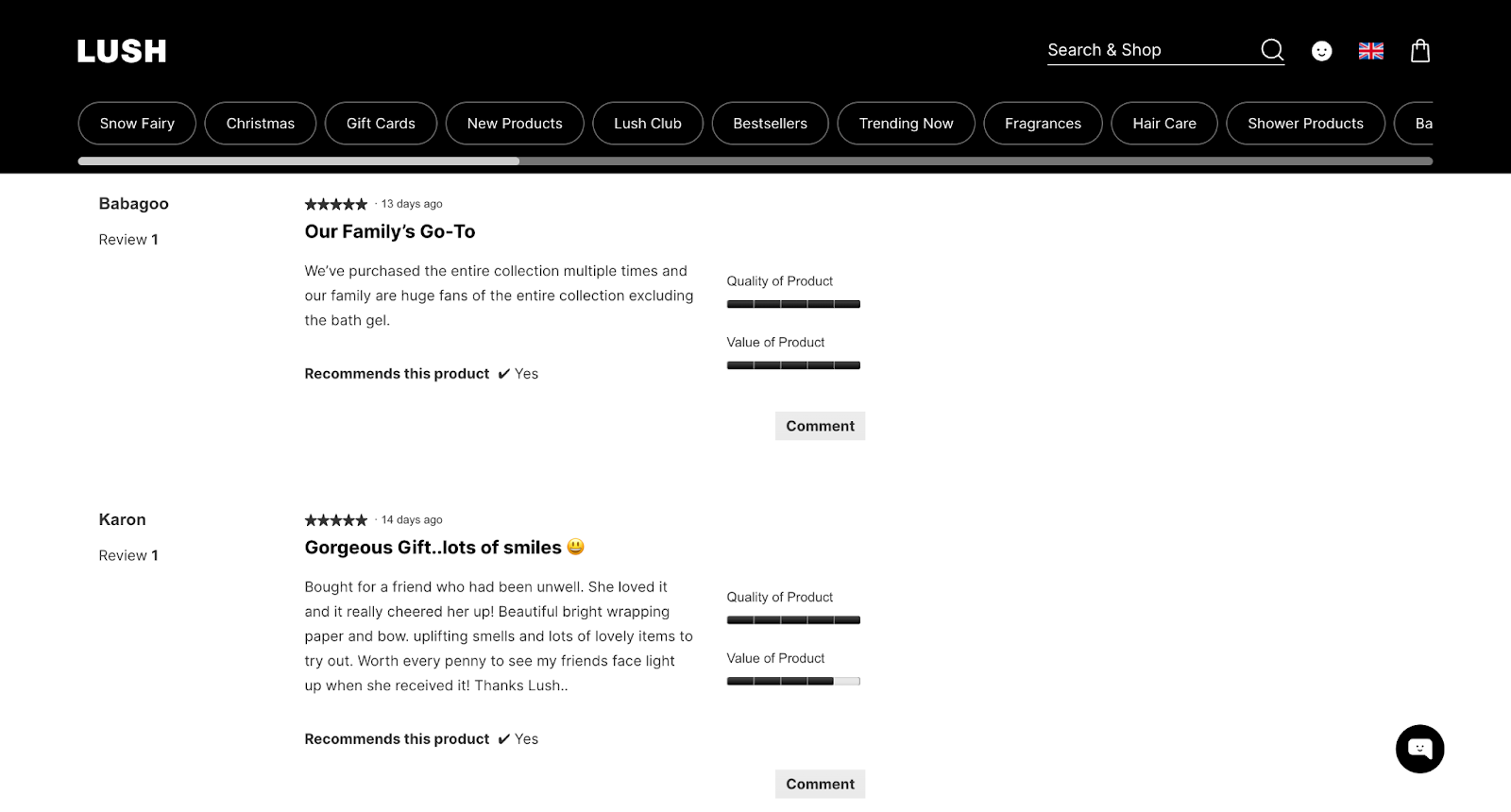
- Customer reviews and testimonials: These answer the most basic buying question: “Did this work for someone like me?” Reviews reduce risk, validate expectations, and support comparison. Their value increases when they’re recent, specific, and surfaced beyond just the product page.

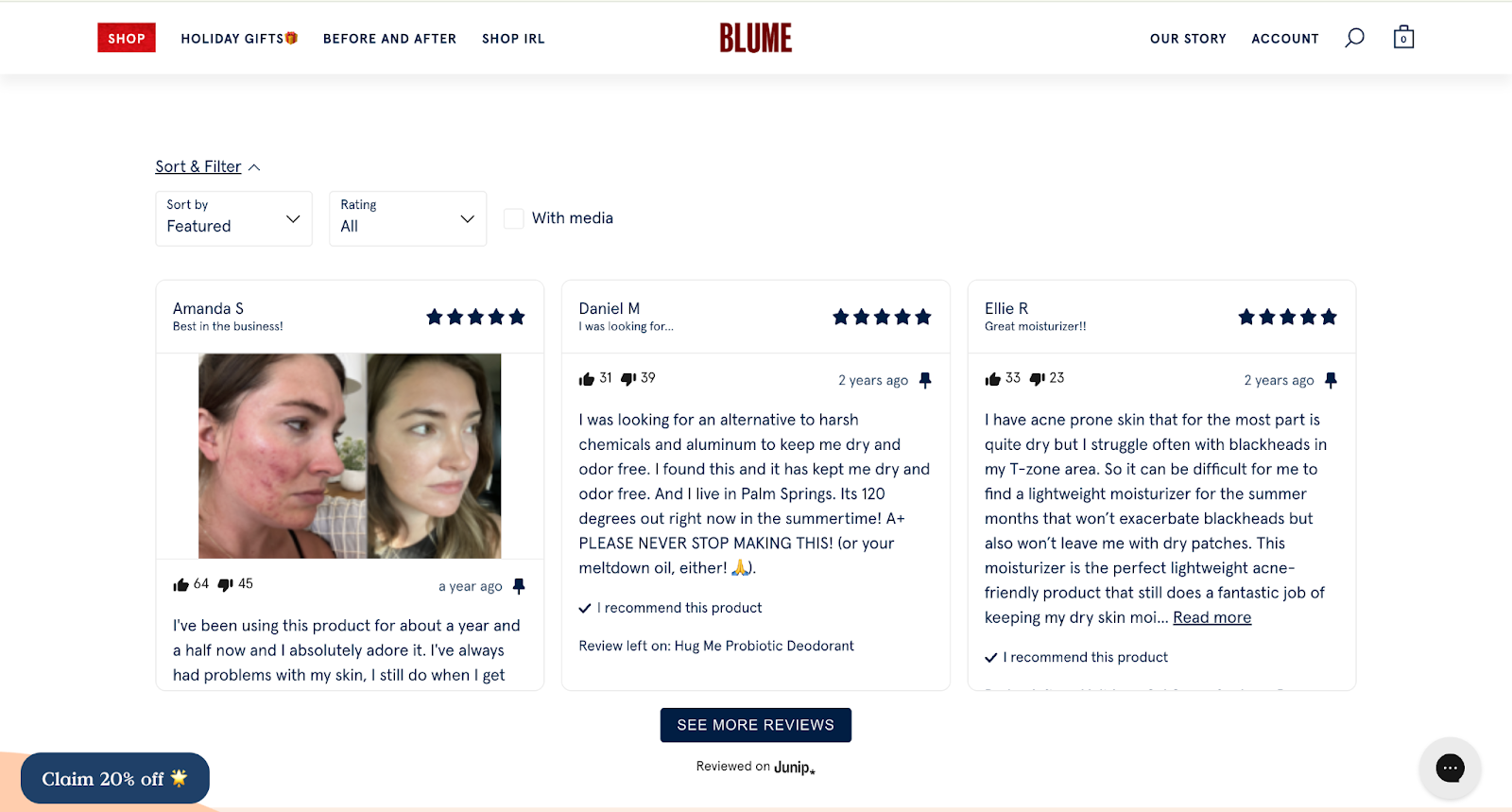
- UGC (photos, videos, routines, before/after): UGC shows real-world usage. It helps buyers visualise outcomes, fit, and experience. This type of proof works best when it reflects everyday customers and is reused across product pages, emails, and paid channels.
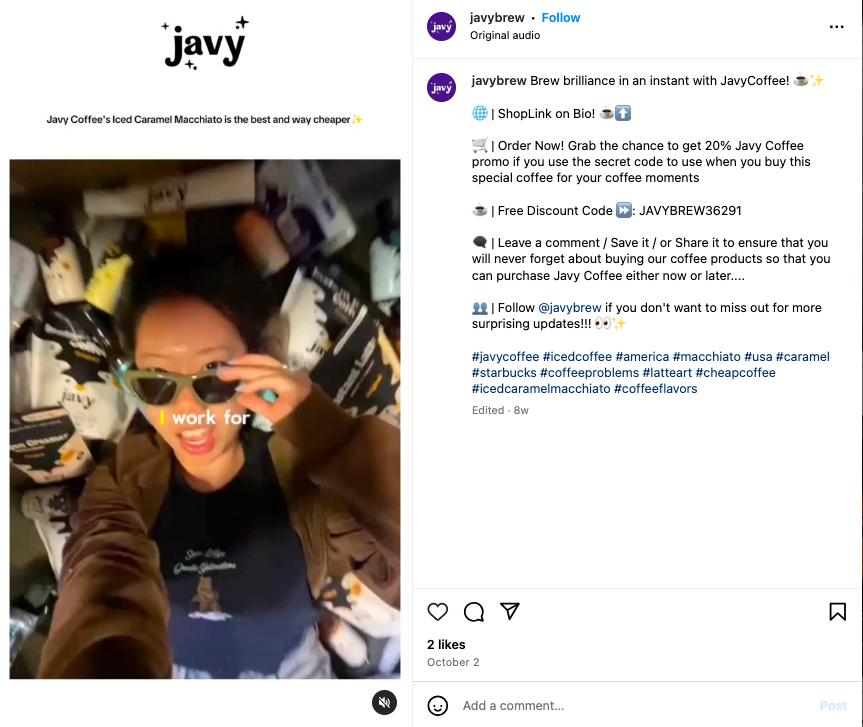
- Creator content and endorsements: Creator content adds credibility through demonstration and explanation. It introduces products in context, handles objections naturally, and influences discovery. When reused strategically, it supports both awareness and conversion without feeling scripted.

- Community conversations (comments, replies, tags): These signals show that people are actively engaging with your brand. Comments, replies, and tagged posts act as live validation. They reassure buyers that the brand is visible, discussed, and trusted in real conversations.
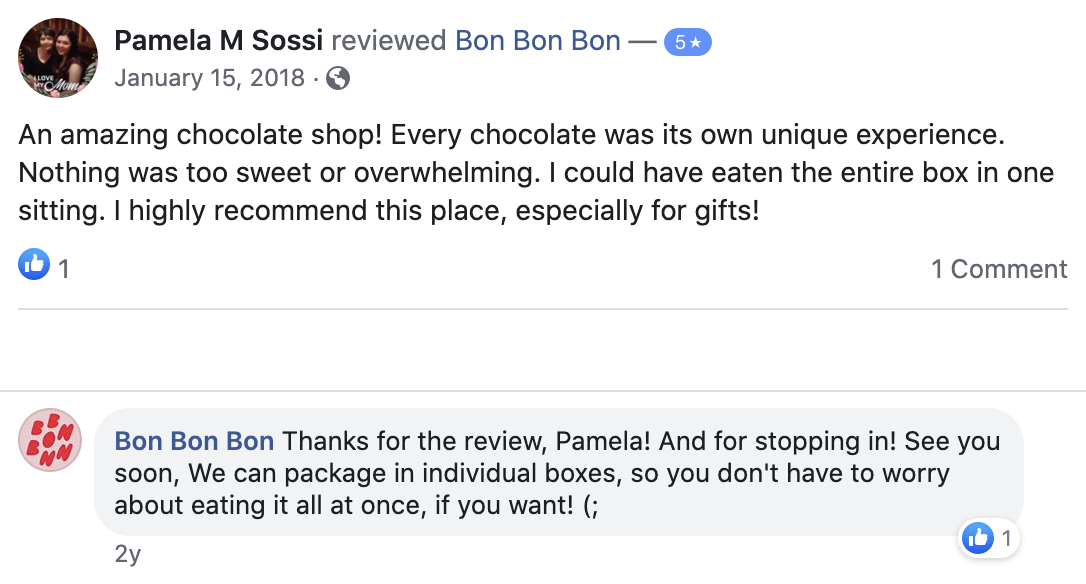
- Referral and affiliate signals: Referral and affiliate activity boost brand advocacy. When customers and creators actively share affiliate links, codes, or recommendations, it signals confidence and satisfaction.

How to collect and manage social proof consistently
To build a social proof ecosystem, you need to decide in advance when proof is requested, what format you capture, how it’s tagged, and where it's used next. When proof follows a defined sequence, it stays usable and shows up exactly when buyers need reassurance.
Here’s how to collect and manage social proof consistently:
- Trigger proof at moments of momentum: Request proof immediately after positive signals like first successful use, repeat purchase, referral completion, or a creator post that drives engagement. These moments produce specific, experience-based responses instead of generic feedback.
- Ask with contextual, use-case-specific prompts: Reference what the customer or creator just did. Ask about outcomes, use cases, or routines they followed. This gives you proof that maps directly to buyer intent.
- Incentivize participation without hurting authenticity: Reward contribution with visibility, early access, or small perks, not scripted outcomes. Keep incentives consistent so contributors feel recognized without shaping what they say.
- Collect proof in multiple formats: Request short videos, photos, routines, progress updates, and written feedback. Multiple formats make proof reusable across product pages, emails, ads, and post-purchase flows.
- Activate affiliates and creators as proof engines: Set expectations at onboarding for ongoing sharing. Define when contributors should post again and what type of proof to capture as performance milestones are hit.
- Collect proof from communities and conversations: Monitor comments, replies, tags, and DMs for clear buying signals and product praise. Capture these in real time while the context is intact.
- Match proof to buyer intent and funnel stage: Tag each asset by product, use case, format, and funnel stage. This makes it easy to surface the right proof during discovery, evaluation, or purchase without rework.
- Create feedback loops that reward participation: Track which proof drives clicks, conversions, or returns. Reuse high-impact assets and request similar proof from future contributors.
- Centralize and tag proof as it comes in: Store every review, UGC clip, creator post, and referral mention in one system with clear tags for product, use case, and funnel stage. This allows proof to be deployed instantly across product pages, emails, and ads when buyers hesitate.
Where social proof should live across the funnel
Social proof works only when it shows up at the exact moment a buyer pauses, questions, or reconsiders. That means you need to place it intentionally across the funnel, not just where it’s easy to add. Each touchpoint has a specific job, and the proof you surface there should match the decision being made.
Here’s how to place proof so it drives action at every stage:
Product pages (reviews, UGC, FAQs)
This is where buyers look for confirmation before committing.
- Surface recent, specific reviews that mention outcomes, fit, or results.
- Add UGC that shows real usage and before/after context.
- Use FAQs to highlight proof-backed answers to common objections, rather than generic claims.
Landing pages and paid ads
Use proof that stops the scroll and validates the promise fast. Short creator clips, strong testimonials, or clear performance outcomes work best for high-converting landing pages.
The goal is to establish credibility fast so the offer feels worth exploring.
Email and SMS flows
Insert proof at moments of hesitation, such as browse abandonment, cart abandonment, and replenishment reminders. Match proof to the reason the buyer might be delaying, whether that’s uncertainty, comparison, or timing.

Post-purchase and onboarding journeys
Proof doesn’t stop after checkout.
- Reinforce the decision with examples of how others use the product.
- Set expectations around results and next steps.
This reduces buyer’s remorse and supports repeat purchases.

Community and social channels
Keep validation visible where conversations already happen. Repost customer content, highlight comments, and acknowledge tags in online communities.
This signals ongoing activity and reinforces trust publicly..

How to activate and redistribute social proof
Collecting proof gives you raw material. Activation is where that proof starts influencing revenue by showing up in high-impact moments.
Here are practical ways to activate and redistribute social proof:
- Turn high-performing UGC into ads and emails: Identify content that drives clicks, saves, or conversion rates. Repurpose those exact assets into paid ads, landing pages, and email creatives instead of starting from scratch.
- Feature proof in lifecycle moments: Add proof to flows where hesitation is expected, like browse abandonment, cart abandonment, replenishment reminders, and win-back sequences. Match the proof to the objection at that stage, such as uncertainty, comparison, or timing.
- Highlight real customer stories: Prioritize proof that explains context, like why someone bought, how they used the product, and what changed. Specific stories outperform broad statements of satisfaction.
- Rotate proof by season, product, and audience: Update assets to reflect current use cases— seasonal routines, product-specific outcomes, or audience-relevant examples. Stale proof loses relevance quickly.
- Retire low-performing or outdated proof: Review proof regularly and remove assets that no longer support engagement or conversions. Using underperforming content creates noise and weakens credibility.
- Update language to mirror current buyer concerns: Refresh headlines, captions, and snippets with language that customers actually use in reviews, comments, and messages. This keeps proof aligned with how buyers think and search.
Measuring the impact of your social proof ecosystem
If social proof is part of your funnel, you should measure it the same way you measure any other growth input. The goal is to understand where it works, how it supports decisions, and what to scale next.
Focus on three signal types:
- Conversion lift by placement: Track how key pages and flows perform before and after proof is added. Measure lift at the placement level, like product pages, landing pages, and abandonment emails.
- Assisted revenue from proof-led flows: Look at assisted conversions from flows that include proof, such as cart recovery, replenishment, or win-back. This shows how proof contributes to revenue across multiple touchpoints.
- Engagement and retention indicators: Monitor saves, clicks, replies, repeat visits, and repeat purchases where proof is present. Strong proof doesn’t just convert once. It increases confidence after purchase and brings customers back sooner.
Common mistakes to avoid
Most social proof failures come from execution, not effort. The signals exist, but they’re edited, placed, or used in ways that weaken trust rather than build it.
The mistakes below show up when proof is treated as a design element rather than a decision-support tool.
- Don’t over-polish proof: When you rewrite customer words, script creator clips, or overproduce visuals, you miss out on the detail that buyers look for. Leave in specifics, rough edges, and context. That’s what makes proof believable.
- Don’t rely only on star ratings: Ratings confirm that people actually purchased a product. But they don’t explain why, how it fits into a routine, or what changed after purchase. Buyers still look for that information elsewhere.
- Don’t use proof without relevance: Proof needs to align with the decision happening on that page or in that flow. When it doesn’t, it gets ignored. Relevance matters more than volume.
Ready to leverage social proof to drive sales?
Social proof works when it stays in circulation. When proof shows up early, carries through the journey, and gets reused based on what actually influences decisions, it stops being decorative and starts driving results across the funnel.
That’s why systems outperform one-off campaigns. A single review or creator post might help once. A social proof ecosystem keeps answering buyer questions every time new traffic arrives. The impact compounds instead of resetting.
Your next steps are straightforward:
- Audit where proof already exists across reviews, UGC, creators, affiliates, and community.
- Identify where buyers hesitate and which proof removes that friction.
- Centralize, tag, and redeploy high-performing proof so it keeps working
This is where Social Snowball fits in. It gives you one dashboard to collect, track, and activate social proof through affiliates, creators, and customers without manual work or scattered tools.

.webp)

.webp)


